Hey curious people of the internet - you too can answer these questions! Search our library of 280+ blogging templates here.
1. What do you currently do and what’s your favorite part about it?
I'm currently a Senior Engineering Manager for Google Cloud Platform at Best Buy, where I lead the discovery team for our GCP platform. My favorite part of the job is honestly just getting to explore new GCP services as they come out and figuring out how they could actually be useful for us. There's something really satisfying about being one of the first people digging into a new tool or feature and connecting the dots between what it does and a real problem we're trying to solve. It keeps the work feeling fresh, even after years of doing this.
2. How did you get started with your Tech Career?
Honestly, it goes back to just having a genuine interest in software from early on. I was drawn to the idea of building things and figuring out how systems actually work under the hood, and that curiosity is really what pulled me into tech in the first place. Over time, that interest turned into a career, and it's kind of stuck with me ever since, because there's always something new to learn or dig into. Tech is one of those fields where the curiosity never really runs out.
3. If Utopia were a color what color do you think it’d be and why?
I'd say yellow. It's warm, optimistic, and kind of energizing, which feels like exactly the vibe a utopia should have. There's nothing heavy or serious about yellow; it just feels open and hopeful, like a place where things are genuinely good rather than just okay. Plus, it's a color that tends to stand out and grab attention in a good way, which feels fitting for something as big as a perfect world
4. If everything about HackerNoon changed drastically, what is one detail you’d like to keep exactly the same? OR What’s your favorite thing to do with HackerNoon and why?
If everything else changed, I'd want the way stories are presented to stay exactly the same. There's something really cool about how the platform lays out and formats content; it just makes technical writing feel more engaging and easy to actually sit down and read. A lot of tech platforms either feel too dry or too cluttered, but HackerNoon manages to keep things clean while still making the content feel alive. That presentation style is honestly a big part of what makes we me want to keep coming back.
5. Tell us more about the things you write/make/manage/build!
Day to day, platform engineering is basically my life; I spend a lot of my time managing and building out our Google Cloud Platform environment, figuring out how new services and capabilities can actually be put to use. Outside of that, I really enjoy writing technical blogs, since it forces me to slow down, think through what I actually understand, and keeps me continuously learning and staying updated on the field. It's become as much a personal practice as anything else, writing things down tends to sharpen how I think about them. So between building platform infrastructure and writing about the space, I'm pretty much always thinking about tech in one form or another.
6. What’s your favorite thing about the internet?
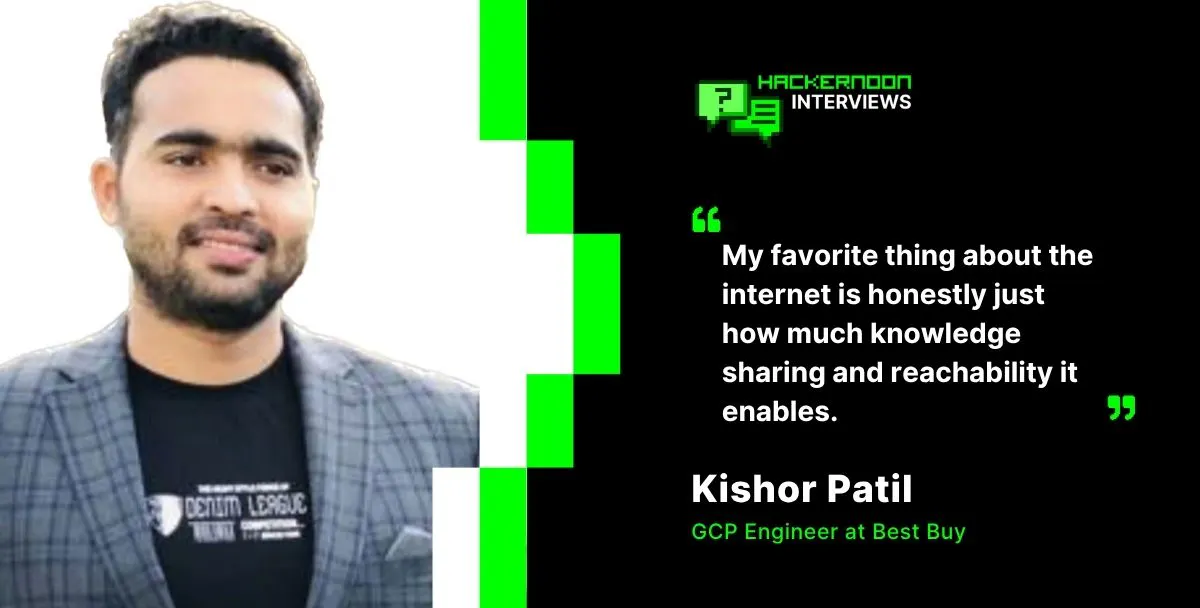
My favorite thing about the internet is honestly just how much knowledge sharing and reachability it enables. You can learn almost anything, from anyone, anywhere in the world, often for free, and that access still feels kind of remarkable to me even after all these years. It's also what makes it possible to connect with people and ideas you'd otherwise never come across, whether that's through a blog post, a forum, or just stumbling onto the right article at the right time. That openness, the fact that knowledge isn't locked behind geography or gatekeepers anymore, is what I appreciate most about it.
7. It’s an apocalypse of ‘walking dead’ proportions and you can only own a singular piece of technology, what would it be?
Honestly, I'd keep my technology book, if I could only hold onto one thing, it'd be that. In a world where everything's falling apart, having something that actually helps me understand and rebuild systems feels a lot more valuable than just another gadget with a battery that'll eventually die anyway. Knowledge is the one piece of tech that doesn't need charging or a signal to keep working. Plus, if I'm going to survive an apocalypse, I might as well spend the downtime learning something useful for whatever comes next.
8. What is your least favorite thing about the internet?
My least favorite thing about the internet is honestly how much misinformation spreads on it. It's the flip side of everything I love about the internet, the same openness that makes knowledge accessible to everyone also makes it incredibly easy for false or misleading information to spread just as fast, if not faster, than the truth. It's harmful in a way that's hard to fully undo once it takes hold, since a lot of people form opinions or make decisions based on things that were never actually accurate to begin with. It's one of those problems that doesn't really have a clean fix, since it's baked into how open and fast the internet is by design.
9. If you were given $10 million to invest in something today what would you invest in and why?
If I had $10 million to invest today, I'd put it into tech stocks. I've spent my career in this space, so I understand the industry, the trends, and where things are actually headed better than I would in a field I don't know as well. Tech has consistently been one of the sectors driving real, tangible change, and I'd rather put my money behind companies and technologies I genuinely believe in and understand, than chase something unfamiliar just because it seems trendy. It plays to what I know, which feels like the smartest way to invest.
10. What’s something you’re currently learning or excited to learn?
Right now, I'm really excited about agentic platform infrastructure and security at scale. As agents become more autonomous and start taking real actions across systems, the infrastructure and security patterns needed to support that safely are still very much being figured out, and I find that genuinely exciting to dig into. It's a space that's evolving fast, so there's a lot of room to actually shape how it gets done right, rather than just following an established playbook. I like being early to something like this, it means the learning curve is steep, but it also means the work actually matters.
11. Would you rather travel 10 years into the past or 10 years into the future? Give reasons for your answer.
I'd choose the past. If I could go back 10 years, there are definitely some decisions, personal and professional, that I'd want to go back and fix or approach differently, knowing what I know now. It's less about nostalgia and more about the idea of getting a second shot at choices that shaped where I ended up. The future is interesting too, but I think there's more value in going back and correcting course than in just watching how things unfold from a distance.
12. How do you feel about AI?
I think AI is an incredibly powerful tool, but it should stay exactly that, a tool that helps us improve and move faster, not something we completely rely on without thinking for ourselves. The risk isn't really the technology itself, it's when people start outsourcing judgment entirely instead of using AI to augment their own thinking and decision-making. Used well, it can genuinely make people and teams better at what they do, but that only works if there's still a human in the loop who understands what's actually happening and can catch it when something goes wrong. So overall, I'm optimistic about it, as long as we're intentional about keeping it as an aid rather than a replacement for our own judgment.